Mood before helmet
What Happens to Safety When We Forget the State We Bring to Work?
This article is based on a presentation I gave at the Shipping Conference in Ålesund together with Mats Aksnes, QHSE Manager at Island Offshore. The presentation was built around a simple but important question: What happens to safety, collaboration, and judgment when we are not aware of the state from which we approach our work?
With the working title "Mood Before Helmet", we wanted to highlight how mood, energy, and emotional state influence risk assessment, reporting, compliance, and psychological safety in operational environments. Helmets, procedures, and systems are essential. But they are always used by people. Therefore, we must also understand the state from which people think, act, and collaborate. Before we put on the helmet, we bring our mood with us. It sounds simple, perhaps too simple. Yet in practice, it can be critical.
In many organizations, we spend a great deal of time discussing safety, procedures, protective equipment, and incidents. We should. Helmets matter. Routines matter. Systems save lives. But before someone follows a procedure, reports a risk, asks for help, stops a job, or listens to a colleague, that person is already in an emotional state. Calm or pressured. Energized or depleted. Confident or uneasy. Open or defensive.
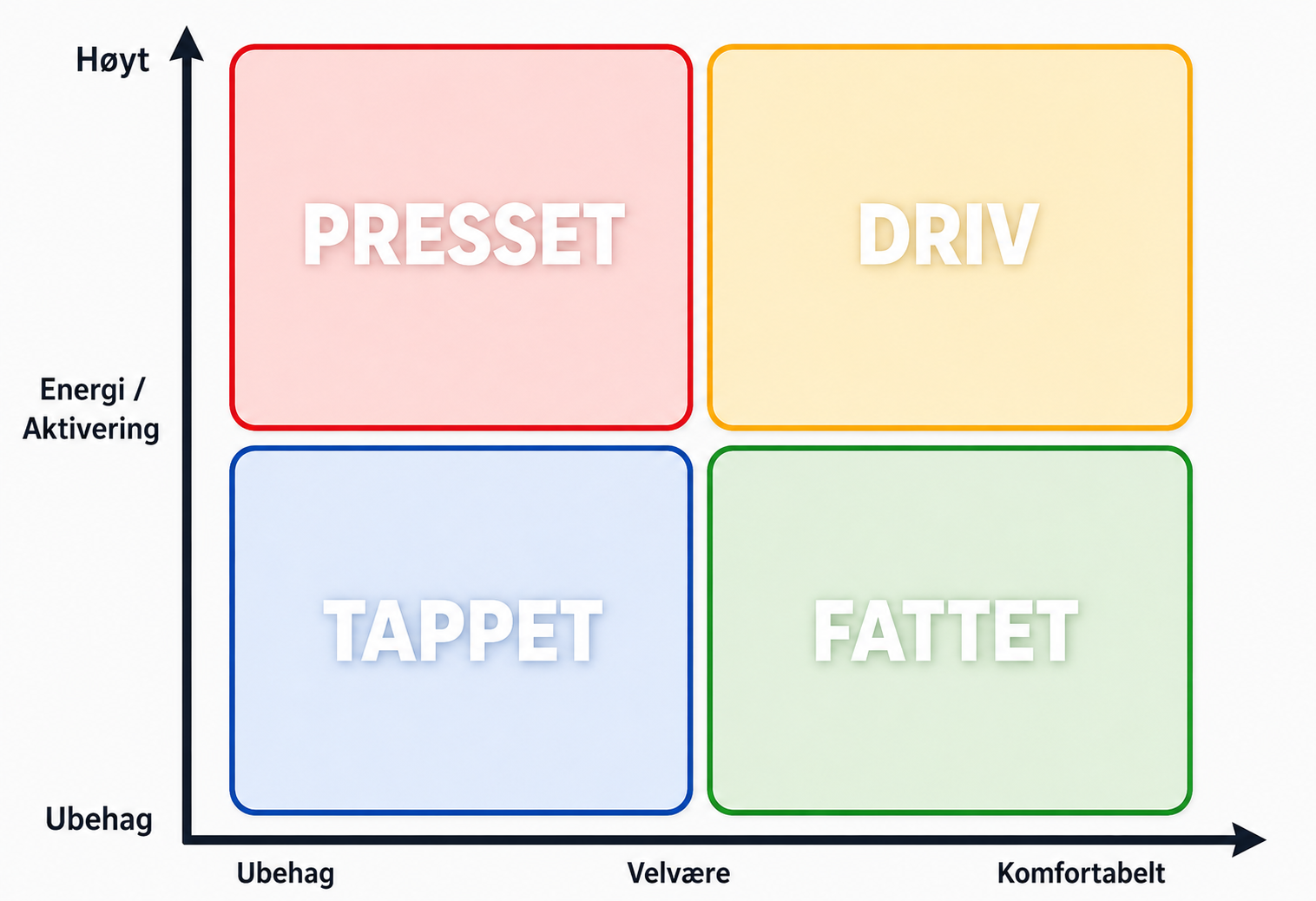
The Mood Map, internationally known as the Mood Meter, helps us put words to these states. The tool is widely recognized through the work of the Yale Center for Emotional Intelligence and the RULER framework. It is based on a simple idea: emotions and moods can be understood through two dimensions—energy and pleasantness/unpleasantness. When we are able to locate ourselves within this landscape, it becomes easier to understand what is happening inside us and what we need in order to respond wisely.
In Symbio's work with the Mood Map, it serves as a practical language for self-leadership, trust, relationships, and psychological safety within teams. The purpose is not to categorize people. The purpose is to recognize our state early enough to adjust our behavior. Because mood is never purely private in the workplace. It affects how we think, listen, react, collaborate, and assess risk.
Mood Is a Guidance System
Mood is not decoration on top of rational thinking. Mood is a biological guidance system that helps us evaluate the world quickly. Is this safe or unsafe? Should I move toward this or away from it? Should I act quickly or wait? Should I mobilize, explore, protect myself, or conserve energy?
The Mood Map is built around two fundamental dimensions.
- The first is energy, which reflects activation levels. Low energy may support rest, reflection, or passivity. High energy may support action, momentum, and mobilization.
- The second is valence, meaning whether a state feels pleasant or unpleasant. Pleasant states make it easier to approach, explore, and collaborate. Unpleasant states make us more focused on protection, avoiding threats, and regaining control.
The combination of energy and valence creates different states. High energy and pleasantness may lead to engagement and initiative. Low energy and pleasantness may create calm and reflection. High energy and unpleasantness may produce stress, irritation, and urgency. Low energy and unpleasantness may result in exhaustion, discouragement, and withdrawal. None of these states are inherently wrong. All serve a purpose. The question is whether we recognize the state we are in and whether we are able to lead ourselves from that state.
The Body Reacts Before the Mind Explains
When something important happens, the body often reacts before conscious thought catches up. Breathing changes. Heart rate increases. The jaw tightens. The voice becomes sharper. The pace accelerates. We interrupt more frequently. Perhaps we begin arguing to win rather than to understand. Only afterward do we create the explanation. This is human. It is also efficient when rapid action is required. However, in leadership, collaboration, and safety-critical work, it can become risky. Many situations require more than reaction. They require response. To react is to allow the state to drive behavior. To respond is to notice the state, create a small space for choice, and decide what the situation actually requires.
This is where self-leadership begins.
Why Mood Comes Before the Helmet
In safety work, we often ask whether people have the correct equipment, the proper training, and the right procedures.These questions matter.
But we should also ask:
- Are we calm enough to see risk?
- Are we psychologically safe enough to speak up?
- Are we open enough to listen?
- Are we too stressed to make sound judgments?
- Are we too fatigued to follow through?
State influences more than collaboration. It affects what we notice, what we overlook, and which risks we choose to act upon. A helmet protects the head from external hazards. The Mood Map helps us recognize internal states that may influence judgment, reporting, compliance, and safe behavior. A pressured employee may avoid asking questions. An irritated manager may dismiss concerns too quickly. An exhausted team may stop following up on weak signals. A group operating at high speed with low psychological safety may begin taking shortcuts. In these situations, the challenge is not only the procedure. The challenge is also the state people are in when the procedure is applied.
The Leader's State Sets the Standard
Mood is contagious. So are stress, calmness, irritation, confidence, and presence. A calm and grounded leader can help others relax. An energetic and optimistic leader can create momentum. A pressured leader can make others more cautious. An irritated leader can silence a team. An exhausted leader can reduce initiative across an entire group.Most of this happens without conscious awareness. People constantly read one another. In uncertain situations, they pay even closer attention to the leader. They notice tone of voice, pace, eye contact, pauses, and subtle shifts in body language.
- Is it safe to speak up right now?
- Can the leader tolerate disagreement?
- Will I be dismissed?
- Is there room to pause and reassess?
For this reason, a leader's mood is not merely a private matter. It becomes part of the work environment. Leaders establish an emotional standard that influences what becomes possible within the team. This does not mean leaders must always be calm or positive. It means they have a responsibility to be aware of their activation state and to regulate themselves before that state undermines trust, quality, or judgment.
The Productive Zone
Many organizations reward speed. This can create the belief that high energy is always desirable. For leaders, however, peak performance rarely comes from maximum energy. The most productive state is often moderate to high energy combined with stable well-being. In this state, leaders maintain momentum without becoming stressed. They communicate clearly without becoming harsh. They move quickly without steamrolling others. They make decisions without developing tunnel vision. We can think of this as the productive zone. Within this zone, leaders balance pressure and composure. That is a critical leadership skill. Not remaining calm at all times, but possessing enough self-awareness to recognize when pressure becomes excessive and enough self-leadership to adjust before it affects others.
When Discomfort Takes Over
Discomfort is not inherently negative. It can generate focus, urgency, and mobilization. However, discomfort also changes the way we think. Attention narrows. Threats become more salient. Thinking becomes more black-and-white. The need for control increases. Curiosity decreases. In practice, leaders may move from seeing the whole picture to focusing on details, from exploration to conclusion, from curiosity to control. In emergencies, this may be necessary. But when it becomes the leader's default mode, relationship quality begins to suffer. Employees may start withholding information. They may soften messages. They may delay speaking up. They may spend more energy reading the leader's mood than solving the task. At that point, mood becomes a safety issue, a trust issue, and a leadership issue.
Self-Leadership Is Recognizing the Shift
The most important aspect of the Mood Map is not identifying the correct position. It is recognizing the shift.
- When do I move from calm to activation?
- When do I move from confidence to uncertainty?
- When do I lose perspective?
- When do I shift from reflection to reaction?
The first signals are often subtle. Tension in the body. Shorter breaths. Faster speech. Reduced patience. A stronger need to win the discussion. Less interest in other perspectives. These are not signs of weakness. They are information. Effective leaders use this information. They notice when they are moving into discomfort. They adjust their behavior before it affects others. They learn to combine energy with composure. That is self-leadership in practice.
Four Simple Actions in the Moment
When you notice that your state may be reducing the quality of a conversation, you do not necessarily need a complex technique. Often, something small and intentional is enough: Pause. Breathe more slowly. Reduce the pace. Ask a question. These four actions may be sufficient to move from reaction to response. Not necessarily back to complete calm, but enough to create choice. And choice is at the core of self-leadership.
What Can Leaders Do in Practice?
1. Make the Mood Map a Shared Language
Use the map in leadership teams, meetings, and reflections. Talk about energy, comfort, and discomfort in a simple, non-threatening way. The goal is not to analyze one another. The goal is to understand how state influences collaboration, decision-making, and safety behavior.
2. Begin Important Meetings by Checking State
Before a demanding task or discussion, ask:
- Where is our energy right now?
- Are we open enough to listen?
- Are we under pressure in ways that may affect our decisions?
- What do we need in order to perform well?
This does not need to take long. Often two minutes is enough.
3. Train Awareness of Your Own Indicators
Every leader should know what happens when they move from comfort to discomfort.
- What happens in my body?
- What happens to my thinking?
- What happens to my voice?
- What happens to my ability to listen?
- What happens to my need for control?
The earlier you notice the signals, the easier it becomes to regulate yourself.
4. Use the Mood Map After Difficult Situations
Following a difficult conversation, an incident, a conflict, or a particularly demanding period, ask:
- Where were we on the Mood Map?
- How did it affect our communication?
- How did it affect our decisions?
- How did it affect psychological safety?
- What can we learn from it?
This is how experience becomes learning.
5. Connect Mood to Risk, Quality, and Compliance
Do not only ask whether the procedure was followed. Also ask what state people were in.
- Were we moving too fast?
- Were we too fatigued?
- Did we feel safe enough to speak up?
- Were we open enough to receive input?
- Was our pace a strength, or did it increase the margin for error?
This makes safety work more human, and often more precise.
Reflection Questions for Leaders
- What characterizes me when I am at my best?
- Where on the Mood Map am I most often when I lead well?
- What happens to me when I move from comfort to discomfort?
- What are my earliest signs of pressure?
- How do others notice my state before I do?
- Do I become more controlling, rushed, quiet, irritated, or avoidant under pressure?
- What do I do to regulate myself before my state affects others?
- What level of energy is most productive for me as a leader?
- How does my mood affect trust within the team?
- How can we use the Mood Map to strengthen reporting, learning, and psychological safety?
Conclusion
Mood before helmet does not mean that mood replaces safety equipment, procedures, or systems. It means that people always approach safety, collaboration, and leadership from an internal state. That state affects what we notice, what we overlook, how we interpret others, how well we listen, how quickly we react, and whether we dare to speak up. The Mood Map provides a simple language for understanding this reality. It helps leaders and teams recognize states, understand reactions, and regulate behavior before trust, quality, or safety are compromised. Because the helmet protects the head. But mood influences how we use it. The quality of safety is determined not only by what we wear on our heads, but by the state from which we think.
References
Barsade, S.G. (2002). The ripple effect: Emotional contagion and its influence on groupbehavior. Administrative Science Quarterly, 47(4), 644–675. https://doi.org/10.2307/3094912
Barsade, S.G., Coutifaris, C. G. V., & Pillemer, J. (2018). Emotional contagion inorganizational life. Research in Organizational Behavior, 38, 137–151. https://doi.org/10.1016/j.riob.2018.11.005
Brackett,M. A. (2019). Permission to feel: Unlocking the power of emotions to helpour kids, ourselves, and our society thrive. Celadon Books.
Edmondson,A. C. (1999). Psychological safety and learning behavior in work teams. AdministrativeScience Quarterly, 44(2), 350–383. https://doi.org/10.2307/2666999
Russell, J.A. (1980). A circumplex model of affect. Journal of Personality and Social Psychology, 39(6), 1161–1178. https://doi.org/10.1037/h0077714
Yale Center for Emotional Intelligence. (n.d.). RULER and the Mood Meter. Yale University.